
Using 50% NaOH in Wastewater Treatment: Dosing & Jar Test
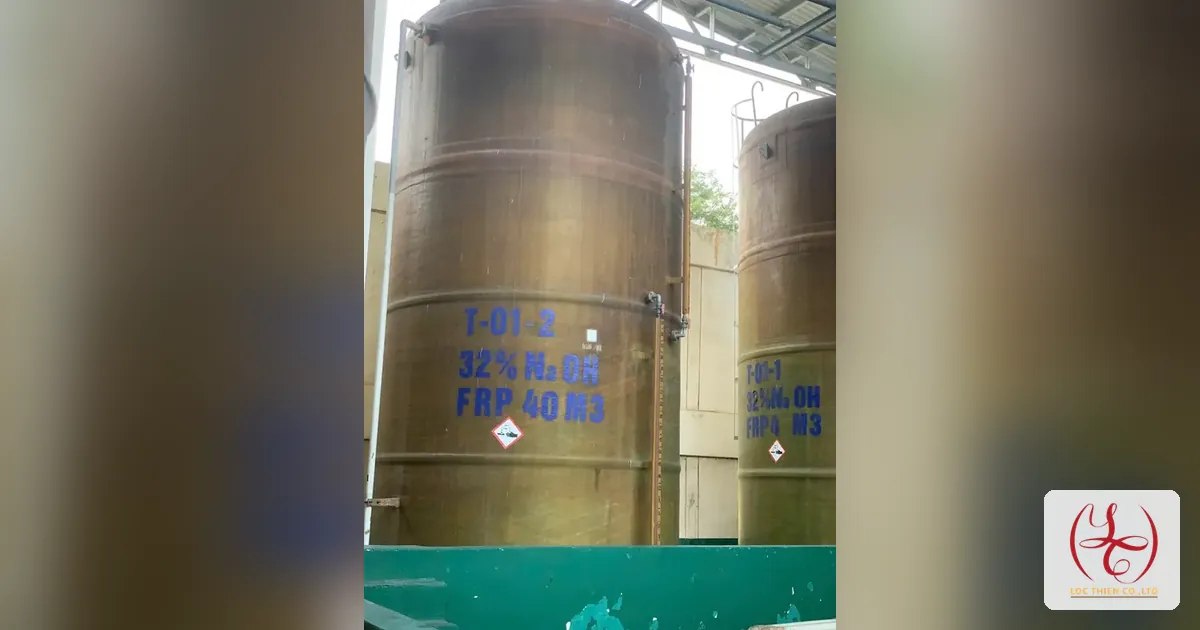
50% NaOH raises the pH of acidic wastewater into the discharge range and precipitates heavy metals as hydroxides. The theoretical dose comes from the moles of H⁺ to neutralize: for a strong acid at pH 3.5, a 50 m³ tank needs about 1.3 kg of 50% solution. Real wastewater contains buffers and metals, so the true dose is several times higher: titrate or jar-test a sample, then dose in steps while watching the pH.
Once you have jar-test results, use the chemical dosing calculator to convert them into the product quantity to order each day. Check that the concentration and density selected in the tool match 50% NaOH.
Contents
- What is 50% NaOH? Basic data and the composition of 1 m³
- Dose calculation: start from moles of H⁺, not from ΔpH
- How the 50% NaOH dose differs between wastewater types
- Mechanisms: neutralization, metal precipitation, saponification of grease
- Worked example: switching from 32% to 50% NaOH
- Advantages and drawbacks
- Safe use
- Supply of 50% NaOH for factories
- Frequently asked questions
What is 50% NaOH? Basic data and the composition of 1 m³
50% NaOH is a sodium hydroxide (caustic soda) solution containing 50% NaOH by mass: strongly alkaline, colorless and slightly viscous. Of the three common liquid caustic concentrations (32%, 45%, 50%), it is the most concentrated. Factories receive it by tanker truck or 1,000 L IBC tote and pump it into a dedicated storage tank for the wastewater plant.
| Parameter | Value |
|---|---|
| Name / CAS | Sodium hydroxide / 1310-73-2 |
| Transport classification | UN 1824, class 8 (corrosive) |
| Content | 50% by mass (company convention ±1%) |
| Density at 20°C | about 1.52–1.53 g/cm³ (CRC reference table: 1.5253) |
| Molar concentration | about 19 mol/L |
| Crystallization temperature | about 12°C |
| Materials that must not contact it | aluminium, tin, zinc (they release H₂, which can explode) |
Lot-specific values come from the test-result sheet/COA where one exists for the item (it depends on the product and is confirmed when we quote). The density used in this article comes from the reference table for calculation; it does not replace the measured value for the lot you receive.
Composition of 1 m³. One cubic metre is 1,000 L and weighs 1,000 × 1.5253 = 1,525 kg. At 50% content it holds 0.5 × 1,525 ≈ 763 kg of NaOH and 763 kg of water. With the density rounded to 1.52 this becomes 760 kg NaOH and 760 kg water.
Compared with 32% NaOH. One kilogram of pure NaOH requires 1 ÷ (0.32 × 1.349) = 2.32 L of 32% solution, but only 1 ÷ (0.50 × 1.5253) = 1.31 L of 50% solution. The volume is about 43% smaller. The mass of solution to haul for the same amount of NaOH drops by more than a third (1 − 0.32/0.50 = 0.36). This helps factories with limited space for tanks; in return you must manage crystallization at about 12°C and a higher density (see the advantages and drawbacks section).
In industrial wastewater treatment, NaOH does three jobs: it raises the pH of acidic effluent, it lets heavy metals precipitate as hydroxides, and it hydrolyzes grease. The sections below start with the calculation and only then move on to operation.
Dose calculation: start from moles of H⁺, not from ΔpH
A common question is: “the wastewater is at pH 3.5 and must reach 7.5 in a 50 m³ tank, how many kilograms of 50% NaOH do I add?” Do not multiply ΔpH by the volume and then by the molar mass. pH is a logarithmic scale: each pH unit is a factor of 10 in H⁺ concentration, so the dose is not linear in ΔpH. The correct calculation starts from the neutralization reaction, in which 1 mol of OH⁻ neutralizes exactly 1 mol of H⁺:
NaOH + HCl → NaCl + H₂O
Strong acid with no buffer (HCl or dilute H₂SO₄, fully dissociated), the steps are:
- [H⁺]₀ = 10^(−pH₀) mol/L
- Moles of OH⁻ required = [H⁺]₀ × V (V in litres)
- Mass of anhydrous NaOH (kg) = moles × 40 ÷ 1,000
- Mass of 50% solution (kg) = anhydrous NaOH ÷ 0.5
- Volume of 50% solution (L) = mass of solution ÷ 1.5253
Example. A 50 m³ tank (50,000 L) at inlet pH 3.5, brought to pH 7:
- [H⁺]₀ = 10^(−3.5) = 3.16 × 10⁻⁴ mol/L
- Moles of OH⁻ = 3.16 × 10⁻⁴ × 50,000 = 15.8 mol
- Anhydrous NaOH = 15.8 × 40 ÷ 1,000 = 0.63 kg
- 50% solution = 0.63 ÷ 0.5 = 1.26 kg, about 0.83 L
So for a purely strong acid the whole 50 m³ tank needs only about 1.3 kg of 50% NaOH solution. The table below gives the theoretical dose for 50 m³ brought to pH 7:
| Inlet pH | Moles of OH⁻ needed | Anhydrous NaOH (kg) | 50% solution (kg) | 50% solution (L) |
|---|---|---|---|---|
| 2.0 | 500 | 20.0 | 40.0 | 26.2 |
| 3.0 | 50.0 | 2.00 | 4.00 | 2.62 |
| 3.5 | 15.8 | 0.632 | 1.26 | 0.829 |
| 4.0 | 5.00 | 0.200 | 0.400 | 0.262 |
| 5.0 | 0.500 | 0.0200 | 0.0400 | 0.0262 |
| 6.0 | 0.0500 | 0.00200 | 0.00400 | 0.00262 |
Each drop of 1 pH unit multiplies the theoretical dose by 10. That is why a calculation linear in ΔpH is wrong by orders of magnitude, and why this table must be read correctly: it is a lower bound on the dose, valid only for water that contains nothing but a strong acid.
Real wastewater almost always contains buffers. Take effluent containing acetic acid (Ka = 1.75 × 10⁻⁵). To sit at pH 3.5, the acid concentration only needs to be about 6.0 mmol/L. But bringing 50 m³ of this water to pH 7 means neutralizing nearly all of the acid, which takes about 300 mol of OH⁻, equal to 12.0 kg of NaOH or 24 kg of 50% solution. At the same pH 3.5 and the same 50 m³, the dose is about 19 times higher than for a strong acid. Bicarbonate alkalinity, organic acids, complexing agents and dissolved metals all push the real dose up in ways the starting pH does not reveal.
Assessment by the Lộc Thiên Technical Department: “At the same pH 3.5, water with only a strong acid needs about 0.63 kg of NaOH for 50 m³, while water buffered with acetic acid needs about 12 kg, a difference of about 19 times. Any reference dose table is therefore only for estimating an order of magnitude; the figure you actually dose must come from titrating a sample of your own wastewater.” — Lộc Thiên Technical Department
How to titrate a sample to fix the dose (in the factory laboratory):
- Take a representative sample of the mixed waste stream (1 L or more) and measure the inlet pH.
- Prepare a standard NaOH solution of about 1 mol/L: add 52.4 mL of 50% NaOH (about 80 g of solution) to water, let it cool and make up to 1 L. Always add caustic to water and wear full protective equipment. For accurate work, standardize the solution against a standard acid.
- Add 1–2 mL portions of the standard solution to the stirred sample, wait for the pH to settle, then record the pH and the volume used until the target pH is reached. For water containing metals, continue through the precipitation range, let it settle, filter and measure the residual metals.
- If 1 L of sample needs V mL of the 1 mol/L solution, the dose is V mol/m³. Conversion: kg of 50% NaOH solution per m³ = 0.08 × V. For example V = 10 mL gives 0.8 kg/m³, so a 50 m³ tank needs 40 kg of 50% solution.
- In the real tank, dose in steps, stir well, measure the pH after each step and stop at the target pH. The target follows the current QCVN 40 and the factory’s discharge permit.
Running a controlled test before fixing the dose pays off. A plating wastewater plant in a Biên Hòa industrial park (500 m³/day) cut chemical cost by 22% after moving from trial and error to a controlled jar-test procedure. That case concerns FeCl3, not NaOH (details in the article on FeCl3 dosing and preparation for plating wastewater), but the principle is the same: a dose measured on a real sample holds up better than a guessed dose when the wastewater changes or when the figures have to be justified. The step-by-step jar-test method is in the jar-test guide and 7 common mistakes.
How the 50% NaOH dose differs between wastewater types
Two factories in the same industry can still need very different amounts of alkali, because raw materials, technology and the way waste streams are combined differ. This article therefore gives no single “kg/m³ by industry” figure. The table only shows what drives the NaOH demand and how to fix the dose.
| Wastewater type | What drives the NaOH demand | How to fix the dose |
|---|---|---|
| Plating, pickling (strong acid with metals) | Both free H⁺ and dissolved metals: each mole of Cu²⁺, Ni²⁺, Zn²⁺ needs 2 mol of OH⁻, each mole of Cr³⁺ needs 3. Complexing agents keep metals in solution | Titrate through the precipitation range, let it settle, then measure residual metals |
| Wastewater with weak or organic acids (acetic, formic, fatty acids) | Buffering: the total acid is far larger than the H⁺ the pH shows (the acetic example above, about 19 times) | Plot the pH versus alkali curve; do not extrapolate from the initial pH |
| Textile dyeing | Reactive dye streams are already alkaline (reactive dyes fix at pH about 10.5–11) and are usually lowered with acid; NaOH is mainly needed for acidic streams or for pH trimming after treatment | Titrate on the mixed streams, because acidic and alkaline streams cancel each other |
| Food and seafood | Near-neutral pH but buffered by bicarbonate, protein and fatty acids; alkali is used for light adjustment or to help saponify grease | Titrate a mixed sample and follow it shift by shift |
| Rubber (latex) | Organic acids and protein increase alkali consumption | Titrate and follow the pH curve |
How to use this. Measure the pH and alkalinity of the combined stream, titrate as described above, and use the result as the starting dose for the real tank. When production conditions change (a new plating bath, a new dye recipe, a different processing season), titrate again. The discharge limit follows the current QCVN 40 and the factory’s permit.
Mechanisms: neutralization, metal precipitation, saponification of grease
Neutralizing acid. NaOH reacts with mineral acids to give a soluble salt and water: NaOH + HCl → NaCl + H₂O; 2NaOH + H₂SO₄ → Na₂SO₄ + 2H₂O. With organic acids (acetic, formic) the reaction is similar, but buffering makes the pH rise slowly and then jump once the buffer is nearly used up. Dose in steps and measure often so you do not overshoot the stopping point.
Precipitating heavy metals. At a high enough pH, metal ions turn into poorly soluble hydroxides and precipitate:
- Cu²⁺ + 2OH⁻ → Cu(OH)₂↓ (blue precipitate)
- Ni²⁺ + 2OH⁻ → Ni(OH)₂↓ (green precipitate)
- Cr³⁺ + 3OH⁻ → Cr(OH)₃↓ (grey-green precipitate)
Each metal has its own optimum precipitation pH range, and it shifts with the composition of the wastewater, so that range must be found by jar test rather than taken from a generic number. The minimum stoichiometric amount of hydroxide for 1 kg of metal is (calculated in Python from atomic masses):
| Metal | Anhydrous NaOH (kg) / kg metal | 50% solution (kg) / kg metal |
|---|---|---|
| Cu²⁺ | 1.26 | 2.5 |
| Ni²⁺ | 1.36 | 2.7 |
| Zn²⁺ | 1.22 | 2.4 |
| Cr³⁺ | 2.31 | 4.6 |
For example, wastewater with 100 mg/L Ni²⁺ (0.1 kg/m³) needs at least about 0.27 kg of 50% solution per m³ just to precipitate the nickel, not counting the alkali that neutralizes H⁺ and makes up the buffer. If the wastewater contains complexing agents such as ammonia, cyanide, EDTA or citrate, the metals may remain dissolved even at high pH and need separate treatment.
Avoid a large excess of alkali: amphoteric hydroxides such as Zn(OH)₂ and Al(OH)₃ redissolve in excess alkali and return the metal to the water. Excess alkali also pushes the pH out of the discharge range.
Hydrolyzing grease. In food wastewater, NaOH saponifies fats: fat + 3NaOH → glycerol + 3 fatty acid salts (soap). The products dissolve readily and are easier to treat biologically. The reaction is faster with heating and enough retention time; effluent with a lot of grease should go through a mechanical grease trap before the chemical stage to save alkali.
Worked example: switching from 32% to 50% NaOH
This is an illustrative calculation with assumed figures, not data from a specific customer. Assume a plant consumes 100 kg of NaOH (as 100%) per day at the same target pH. Densities come from the reference table: 1.349 for 32% and 1.5253 for 50%.
| Item | 32% NaOH | 50% NaOH | Difference |
|---|---|---|---|
| Solution dosed per day (kg) | 312.5 | 200 | 112.5 kg less |
| Volume per day (L) | 231.7 | 131.1 | 43.4% less |
| Solution per 30-day month (tonnes) | 9.38 | 6.00 | 3.38 tonnes less |
| Pure NaOH in one full 8 m³ tank (tonnes) | 3.45 | 6.10 | 1.77 times more |
| Days one full 8 m³ tank lasts | 34.5 | 61.0 | 1.77 times longer |
Under this assumption one tanker delivery of 5–30 tonnes lasts at least about 25 days (5 tonnes ÷ 200 kg/day), and one full 8 m³ tank lasts about two months. The real number of deliveries depends on each factory’s consumption and tank volume.
On cost: do not compare the price per kilogram of solution directly. The cost per kilogram of 100% NaOH equals the price per kilogram of solution divided by the concentration, so compare P₃₂ ÷ 0.32 with P₅₀ ÷ 0.50. Actual prices depend on volume, delivery area and contract, so this article lists none; contact us for a quote based on your order.
Before changing concentration, check the following:
- Tank material: carbon steel can be used with 50% NaOH up to about 49°C; above that there is a risk of caustic stress corrosion cracking. HDPE can be used up to about 38°C. FRP (vinyl ester resin) tanks need confirmation from the tank manufacturer. PVC/CPVC fittings, 316 stainless steel and EPDM gaskets are commonly used; for harsh conditions consider Hastelloy, PTFE or PVDF. Strictly avoid aluminium, zinc and tin.
- Crystallization: 50% NaOH crystallizes at about 12°C. Keep tanks and pipes well above that point (about 21°C or higher is a commonly used target — follow the guidance of the producer or your system designer) with insulation or heat tracing, especially outdoor tanks when the ambient temperature can drop close to 12°C. Reference figures follow the NaOH–H₂O phase diagram and technical literature from caustic soda producers; the actual crystallization point depends on each batch’s concentration per its COA/TDS.
- Dosing pump and flow meter: density rises by about 13% compared with 32% NaOH (1.5253 ÷ 1.349) and viscosity is higher, so recheck pump capacity and seat valve material and update the density setting on the meter.
- Injection point: place it near the agitator so the concentrated solution mixes quickly and does not stratify.
The Lộc Thiên Technical Department recommends a site survey before the change. Factories new to bulk NaOH should start with 32%, run stably, and only then consider raising the concentration. A detailed comparison of the three concentrations is in 32%, 45% and 50% NaOH: choosing the concentration for operation.
Advantages and drawbacks of 50% NaOH in wastewater treatment
Advantages:
- The most concentrated of the common liquid caustics: for the same amount of NaOH, the storage volume is about 43% smaller than with 32%. Plants with little space for tanks benefit directly.
- Fewer deliveries for the same amount of NaOH: the mass of solution to haul falls by more than a third, so the number of restocking trips falls too.
- Small dosing volume: less dilution of the wastewater and less filling of the reaction tank; the target pH is easier to reach when the wastewater pH is very low.
- Suits metal treatment: it quickly reaches the pH needed to precipitate hydroxides without dosing large volumes of solution.
Drawbacks:
- Strongly corrosive as temperature rises: carbon steel is only suitable within the temperature limit given above; check the tank wall thickness periodically under the factory’s maintenance procedure.
- Crystallizes at about 12°C: higher than the lower concentrations, so outdoor tanks need insulation or heating when the ambient temperature drops close to this point, to prevent blocked lines.
- Pumps and measuring instruments need rechecking because the density and viscosity are higher.
- Dilution releases a lot of heat: if 50% is diluted to a lower concentration the solution heats up quickly, can splash and can deform plastic tanks. Always add caustic to water slowly while stirring, never the other way round.
Safe use of 50% NaOH in wastewater treatment
50% NaOH is a class 8 (corrosive) hazardous chemical, UN 1824. Read the 50% NaOH MSDS before operating and follow these rules.
Personal protective equipment:
- Sealed chemical splash goggles (not ordinary glasses)
- Chemical-resistant gloves with long cuffs
- Chemical-resistant clothing and apron
- Chemical-resistant rubber boots (not fabric shoes)
- Face shield when opening the tank bottom valve or connecting a tanker
Operating procedure:
- Check valves, pipes and the tank before every shift: no leaks and no abnormal signs of corrosion.
- Open valves slowly, never suddenly, because the flow can splash chemical.
- Dose NaOH into the reaction tank near the agitator so the solution dissolves quickly and does not stratify.
- Measure pH continuously and stop dosing at the target pH; excess alkali wastes chemical and can redissolve some hydroxides.
- Label the tank clearly: chemical name, concentration and corrosion warning.
In case of contact:
- Skin: remove contaminated clothing and rinse immediately with plenty of clean water until medical staff take over.
- Eyes: rinse immediately with plenty of clean water (the MSDS states at least 10 minutes), continue if emergency care has not arrived, then see an eye doctor.
- Inhaling vapor or mist: move the person to fresh air; if breathing is difficult, call emergency services (115 in Vietnam).
Emergency eyewash stations and safety showers should be close to the transfer area, with an unobstructed path, inspected regularly and logged. The MSDS/SDS comes with the quotation so operators can look things up on site.
Supply of 50% NaOH for factories
Hóa Chất Lộc Thiên supplies 50% NaOH in bulk to factories and industrial parks, with a Vietnamese MSDS/SDS supplied with the quotation; the test-result sheet/COA depends on the item and is confirmed when we quote. Delivery is by 5–30 tonne tanker or 1,000 L IBC tote depending on the order.
Indicative delivery times: inner Ho Chi Minh City within about 4 hours; industrial parks in the South and Mekong Delta 24–48 hours; North and Central Vietnam 2–3 days. Goods ship from 6 warehouses across 3 regions. Quotes are returned within 15 minutes once you send the product, quantity and delivery location; hotline 0979 891 929.
For specifications and packaging, see the 50% liquid NaOH product page or the overview article 50% NaOH: specifications, applications and quotation. For diluting caustic from concentrated solution see how to prepare caustic soda in wastewater treatment; this article focuses on operation in wastewater treatment.
Frequently asked questions about using 50% NaOH in wastewater treatment
How does 50% NaOH differ from 32% NaOH in wastewater treatment?
50% NaOH contains 500 g of pure NaOH per kg of solution, while 32% contains 320 g. To reach the same target pH, the volume of 50% solution to dose is about 43% smaller than with 32%. In return the density is about 13% higher (1.5253 versus 1.349 g/cm³) and it crystallizes at about 12°C, so dosing pumps, flow meters and pipe insulation must be checked.
What is the dose formula for 50% NaOH in a treatment tank?
For water containing only a strong acid: moles of OH⁻ = 10^(−pH) × V (litres); anhydrous NaOH (kg) = moles × 40 ÷ 1,000; 50% solution (kg) = anhydrous NaOH ÷ 0.5. For example pH 3.5 and a 50 m³ tank needs about 15.8 mol, which is about 1.3 kg of 50% solution. This is the theoretical minimum; real wastewater has buffers and metals, so titrate a sample or run a jar test.
Why not calculate the dose linearly from ΔpH?
Because pH is a logarithmic scale. A drop of 1 pH unit means the H⁺ concentration is 10 times higher, so the theoretical dose is multiplied by 10 rather than increased by a fixed amount. In addition, buffers in wastewater make the real dose very different from the dose calculated from pH: an acetic buffer at pH 3.5 needs about 19 times the dose of a strong acid at the same pH.
What is the 50% NaOH dose for plating wastewater?
There is no generic figure, because the dose depends on free H⁺, the dissolved metals and any complexing agents. As a stoichiometric reference, each kg of Cu²⁺, Ni²⁺ or Zn²⁺ needs at least about 2.4–2.7 kg of 50% solution to precipitate as hydroxide, and Cr³⁺ about 4.6 kg. The exact dose comes from titrating a sample of your own wastewater.
Can 50% NaOH precipitate heavy metals?
Yes. NaOH raises the pH to the range where Cu²⁺, Ni²⁺, Zn²⁺ and Cr³⁺ precipitate as poorly soluble hydroxides; the optimum pH range of each metal depends on the wastewater composition, so determine it by jar test. Avoid excess alkali because Zn(OH)₂ and Al(OH)₃ redissolve in excess alkali, and complexing agents can keep metals in solution.
How should 50% NaOH be stored, and what should the tank be made of?
50% NaOH crystallizes at about 12°C, so keep tanks and pipes well above that point (about 21°C or higher is a commonly used target — follow the guidance of the producer or your system designer), while also avoiding excessive temperature. Tank materials: carbon steel (up to about 49°C; above that there is a risk of caustic stress corrosion cracking), HDPE (up to about 38°C) or vinyl ester FRP (confirm with the tank manufacturer). Fittings are usually PVC/CPVC or 316 stainless steel with EPDM gaskets; for harsh conditions use Hastelloy, PTFE or PVDF. Do not use aluminium, zinc, tin or their alloys, because they generate explosive hydrogen.
Can 50% NaOH treat grease in wastewater?
Yes, through saponification: fat + NaOH → glycerol + soluble fatty acid salt. The reaction is faster with heating and enough retention time. Wastewater with a lot of grease should first go through a mechanical grease trap, because mechanical removal uses less alkali than saponifying all of it.
How do I check 50% NaOH quality on receipt?
Measure the density with a hydrometer at 20°C and compare it with the lot’s test-result sheet/COA if one is available (correct for temperature if measured at another temperature). For a more accurate concentration, titrate a sample against a standard acid. How to read a hydrometer and convert to concentration is covered in checking NaOH concentration with a hydrometer. The test-result sheet/COA depends on the item and is confirmed when we quote.
When should I use 50% NaOH instead of 32% NaOH?
When the plant has limited space for tanks, wants fewer deliveries, or has wastewater with a very low pH that needs concentrated alkali in a small volume. Factories new to bulk NaOH should start with 32% for simpler operation, then consider a higher concentration once the process is stable.
Does Lộc Thiên deliver 50% NaOH by tanker?
Yes. Lộc Thiên delivers 50% NaOH by 5–30 tonne tanker or 1,000 L IBC tote depending on the order, from 6 warehouses across 3 regions. Indicative delivery times: inner Ho Chi Minh City about 4 hours, industrial parks in the South and Mekong Delta 24–48 hours, North and Central Vietnam 2–3 days. The Vietnamese MSDS/SDS comes with the quotation; the test-result sheet/COA depends on the item and is confirmed when we quote.
Request a quote or technical advice
Send the product, expected quantity and delivery industrial park through the contact page or by email at [email protected] to receive a quote within 15 minutes; hotline 0979 891 929. See also the 50% NaOH MSDS and the overview article on 50% NaOH.