Sodium Sulfate Anhydrous Na₂SO₄ 99% in Cotton Reactive Dyeing: Zeta Potential Control & ZDHC MRSL v3.1 Compliance
Table of contents
Sodium Sulfate Anhydrous (Na₂SO₄ ≥ 99.0% w/w, CAS 7757-82-6, anhydrous Glauber’s salt) is the primary neutral electrolyte used in cotton knit and woven dyeing mills to compress the negative electrical double layer (Zeta potential ζ) on cellulose fibers in water, driving primary reactive dye exhaustion (E%) from ≤ 25% up to 65% – 85% prior to alkali fixation. Loc Thien Chemical is a commercial industrial chemical supplier of Sodium Sulfate Anhydrous Na₂SO₄ 99% certified to ZDHC MRSL v3.1 Conformance Level 1 by TÜV SÜD Product Service GmbH (Certificate No. ZDHC1 127736 0003 Rev. 00 | Report No. 2438023996), packed in moisture-barrier PE-lined 50 kg PP bags with batch-specific COA and MSDS Na₂SO₄ across 6 regional warehouses in Vietnam.
1. Why Does Cotton Reactive Dyeing Require High Electrolyte Concentrations of Na₂SO₄ 99% to Overcome the Zeta Potential Barrier?
When scoured and bleached cotton cellulose fibers (Cell-OH) are immersed in a neutral or weakly alkaline dyebath (pH 6.5 – 7.5), surface hydroxyl and trace carboxyl groups ionize, generating a strongly negative surface Zeta potential (ζ ranging from -35 mV to -50 mV). Simultaneously, water-soluble reactive dyes (such as Vinyl Sulfone or Monochlorotriazine types) contain 2 to 4 sulfonate groups (-SO₃Na → -SO₃⁻ + Na⁺), carrying a high negative charge density.
Without a concentrated electrolyte such as Sodium Sulfate Anhydrous Na₂SO₄ 99%, electrostatic repulsion between the negatively charged fiber surface and the anionic dye molecules prevents dye diffusion into the amorphous regions of the cotton fiber:
- Compression of the Gouy-Chapman Diffuse Double Layer (Debye Length
κ⁻¹Reduction):- Dissolving
30 – 90 g/LofNa₂SO₄releases a high density of hydrated sodium cations (Na⁺). Each mole ofNa₂SO₄(M = 142.04 g/mol) dissociates into2 mol Na⁺and1 mol SO₄²⁻, increasing the ionic strength (I = ½ Σ cᵢzᵢ²) of the dyebath threefold per molar unit. - Counter-ions (
Na⁺) accumulate around the cellulose interface, compressing the thickness of the electrical double layer (κ⁻¹) from~8.5 nmdown to≤ 0.8 nmand reducing the Zeta potential magnitude from-45 mVto-12 mVto-15 mV. Once the energy barrier falls below the thermal kinetic energy of the dye molecules at60°C – 80°C, dye anions rapidly adsorb onto the cellulose nanopores.
- Dissolving
- Hofmeister Salting-Out Effect of Divalent Sulfate Ions (
SO₄²⁻):- In the Hofmeister lyotropic series (
SO₄²⁻ > Cl⁻ > NO₃⁻), the divalent sulfate anion (SO₄²⁻) exhibits strong hydration energy, competing for free water molecules and lowering the thermodynamic solubility of reactive dye anions in the bulk liquor. This chemical potential gradient pushes dye molecules out of the aqueous phase and onto the cotton substrate (Substantivity Phase).
- In the Hofmeister lyotropic series (
- Why Export FDI Dyehouses Prefer
Na₂SO₄ 99%Over IndustrialNaClfor Critical Shades and Stainless Steel Jet Machines:- Unlike chloride ions (
Cl⁻), which penetrate the passive chromium oxide (Cr₂O₃) film ofSUS304 / SUS316Ldyeing vessels at80°C – 130°Cand trigger pitting and stress corrosion cracking, the sulfate ion (SO₄²⁻) is non-corrosive to stainless steel nozzles, heat exchangers, and circulation pumps. - For high-aggregation dyes such as Turquoise Blue (Phthalocyanine reactive dyes, e.g., C.I. Reactive Blue 21), Emerald Green, and Navy Blue,
Na₂SO₄provides gentler, more uniform exhaustion kinetics thanNaCl, preventing dye precipitation and salt-spot defects (ΔE*ab > 1.0).
- Unlike chloride ions (
2. What Technical Specifications Must Textile-Grade Na₂SO₄ 99% Meet Under COA & TÜV SÜD ZDHC Level 1?
For export textile mills supplying global brands (Nike, Adidas, Zara/Inditex, Uniqlo, H&M, Puma), even trace levels of calcium (Ca²⁺), magnesium (Mg²⁺), or ferric iron (Fe³⁺) in bulk salt will chelate with reactive dyes, causing insoluble dye-metal specks and shade dulling. Below is the technical specification table for Sodium Sulfate Anhydrous Na₂SO₄ 99% supplied by Loc Thien Chemical:
| Parameter | Typical Value / Specification Limit | Test Method / Textile Technical Significance |
|---|---|---|
Assay (Na₂SO₄ on dry basis) | ≥ 99.0% – 99.3% w/w | GB/T 6009-2014 (Type I Class A) · Ensures exact batch-to-batch ionic strength |
pH of 5% w/v Aqueous Solution (at 20 °C) | 6.0 – 8.0 (Neutral) | ISO 787-9 · Prevents premature alkaline hydrolysis of Vinyl Sulfone dyes during exhaustion |
| Water Insoluble Matter | ≤ 0.05% w/w | Gravimetric 0.45 µm filtration · Prevents nozzle clogging in high-speed Jet and Package dyeing |
Total Calcium & Magnesium (as Ca²⁺ + Mg²⁺) | ≤ 0.10% w/w (Typical ≤ 350 ppm) | EDTA Complexometric Titration · Eliminates calcium-dye lake precipitation and fabric harshness |
Total Iron (as Fe) | ≤ 0.002% w/w (≤ 20 ppm) | 1,10-Phenanthroline Spectrophotometry · Protects whiteness and pastel brilliance |
Moisture Content (Loss on Drying at 105 °C) | ≤ 0.20% w/w | Free-flowing crystalline powder; resists caking in pneumatic salt-dissolving hoppers |
| Whiteness (Hunter Whiteness Index) | ≥ 85% – 90% | Optical Reflectance · Zero discoloration of optical brightened or pastel fabrics |
| ZDHC MRSL v3.1 Conformance | Level 1 Certificate | Certified by TÜV SÜD Product Service GmbH (Cert No. ZDHC1 127736 0003 Rev. 00 | Report No. 2438023996) |
Expert Technical Note — QC Specialist Phan Cam Thuy (Loc Thien Chemical): “When dissolving
50 – 80 g/Lof salt at liquor ratio1:8, an impure salt containing0.35% Ca/Mginjects nearly280 mg/Lof hardness ions into the dyebath—completely overwhelming standard1 – 2 g/Lchelating agents. Switching toNa₂SO₄ ≥ 99.0%withFe ≤ 20 ppmandTÜV SÜD ZDHC Level 1certification eliminates recurrent salt-spot re-dyeing on Turquoise and Navy lots.”
3. How Much Na₂SO₄ 99% Should Be Dosed by Shade Depth (% owf) and Liquor Ratio (L.R.)?
In exhaust dyeing on Jet, Overflow, Airflow, or Cone Package machines, the dosage of Na₂SO₄ is calculated in grams per liter of dyebath (g/L), not solely on fabric weight. As modern low-liquor-ratio machines (L.R. 1:5 to 1:6) replace conventional 1:10 jets, salt concentration per liter is adjusted to maintain thermodynamic exhaustion while avoiding solubility saturation:
Shade Depth Category (% owf Reactive Dye) | Target Color Examples | Na₂SO₄ 99% Dosage at L.R. 1:10 (g/L) | Na₂SO₄ 99% Dosage at L.R. 1:8 (g/L) | Na₂SO₄ 99% Dosage at L.R. 1:6 (g/L) | Progressive Portion Dosing Ratio (3 Steps) |
|---|---|---|---|---|---|
1. Pastel & Pale Shades (≤ 0.5% owf) | Baby Pink, Sky Blue, Mint, Ecru | 15 – 25 g/L | 12 – 20 g/L | 10 – 15 g/L | 20% : 30% : 50% (10 min interval) |
2. Light-to-Medium Shades (0.5% – 1.5% owf) | Heather Grey, Medium Blue, Beige | 30 – 45 g/L | 25 – 40 g/L | 20 – 35 g/L | 20% : 30% : 50% (10 min interval) |
3. Medium-to-Dark Shades (1.5% – 3.0% owf) | Royal Blue, Crimson Red, Olive Green | 50 – 65 g/L | 45 – 60 g/L | 40 – 50 g/L | 30% : 30% : 40% (10–15 min interval) |
4. Deep Navy & Black (3.0% – 6.0% owf) | Reactive Black 5, Deep Navy, Burgundy | 70 – 90 g/L | 65 – 80 g/L | 55 – 70 g/L | 30% : 30% : 40% (15 min interval) |
5. Phthalocyanine Turquoise (1.0% – 3.5% owf) | Reactive Blue 21, Brilliant Emerald | 50 – 75 g/L (Must use Na₂SO₄) | 45 – 65 g/L | 40 – 55 g/L | 15% : 35% : 50% (Pre-dissolved at 50 °C) |
Important Process Control Rule: The dosages above are industrial engineering benchmarks. Actual dyebath recipes must be verified via laboratory lab-dip and pilot testing (
Jar-test / Lab Dyeing) for each cotton yarn count, mercerization degree, and specific bifunctional or Vinyl Sulfone dye series.
4. How to Dissolve and Dose Na₂SO₄ Without Causing Dye Shock or Mirabilite (Na₂SO₄·10H₂O) Pipe Blockage?
- Progressive 3-Portion Salt Addition (
20% – 30% – 50%) to Prevent Unlevel Strike:- Dumping
100%of the requiredNa₂SO₄into the side tank in a single shot causes an instantaneous drop in Zeta potential (ζ), forcing> 50%of the dye onto the outer yarn layers within2 – 3 minutes(Dye Strike Shock). - Standard Operating Procedure: Pre-dissolve
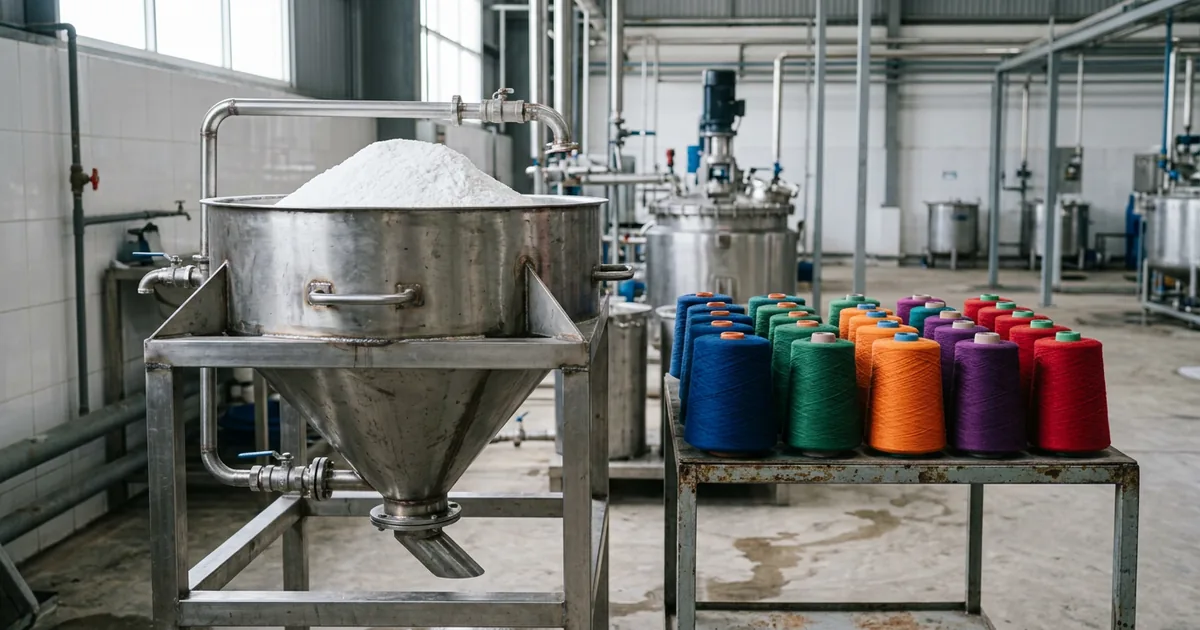
Na₂SO₄in the preparation tank at a concentration of200 – 250 g/L, filter through a100-meshstainless screen, and transfer into the main dyeing circulation loop in 3 progressive portions (20%,30%,50%) spaced10 – 15 minutesapart—before adding Soda Ash Light Na₂CO₃ 99.2% for covalent fixation (pH 10.5 – 11.2).
- Dumping
- Preventing Mirabilite (
Na₂SO₄·10H₂O) Crystallization in Transfer Pipes Below32.4 °C:- Sodium sulfate exhibits an unusual solubility transition at
32.4 °C: above32.4 °C, it exists as anhydrousNa₂SO₄with high solubility (~495 g/L); below32.4 °C, it hydrates into decahydrate Mirabilite (Na₂SO₄·10H₂O), whose solubility drops sharply to139 g/Lat15 °Cand195 g/Lat20 °C. - During cool winter shifts in Northern Vietnam (
Bac Ninh, Hung Yen, Hai Duong, Nam Dinh), concentrated250 g/Lsalt solutions left standing in unheated transfer lines will crystallize into hardNa₂SO₄·10H₂Oplugs. Always maintain the salt dissolving tank at40 °C – 50 °Cusing steam coils and flush transfer lines with warm water (50 L) immediately after dosing.
- Sodium sulfate exhibits an unusual solubility transition at
5. Illustrative Engineering Calculation — Monthly Na₂SO₄ 99% Consumption for a 25-Ton/Day Cotton Knit Dyehouse
Illustrative technical calculation for a cotton knitwear dyeing plant operating at 25 metric tons of fabric/day with an average liquor ratio L.R. = 1:8 (daily main dyebath volume = 25 × 8 = 200 m³/day):
- Shade Mix Breakdown:
30%Light shades (25 g/L),40%Medium shades (50 g/L),30%Dark/Black shades (85 g/L). - Weighted Average
Na₂SO₄Concentration:C_avg = (0.30 × 25) + (0.40 × 50) + (0.30 × 85) = 7.5 + 20.0 + 25.5 = 53.0 kg/m³ of dyebath - Daily & Monthly Consumption (
26 operating days/month):M_day = 200 m³/day × 53.0 kg/m³ = 10,600 kg/day = 10.6 metric tons/day (212 bags of 50 kg/day)M_month = 10.6 × 26 = 275.6 metric tons/month - Effluent Sulfate Control Note: High
SO₄²⁻concentrations (1,500 – 3,500 mg/L) in equalization tanks must be aerated to prevent sulfate-reducing bacteria (SRB) from generating toxicH₂Sgas in anaerobic zones. Loc Thien Chemical manufactures Ferrous Chloride Solution FeCl₂ 30% (TÜV Rheinland ZDHC Level 1 — CSR No. 248162921-02) and supplies PAC 31% (CSR No. 248162921-05) to precipitate sulfides and decolorize reactive dye wastewater to meet Column A ofQCVN 40:2025/BTNMT.
6. GHS Safety, Compliance & Multi-Role Procurement Guide (Procurement / Engineer / Accounting)
- GHS Classification & Handling (MSDS Na₂SO₄):
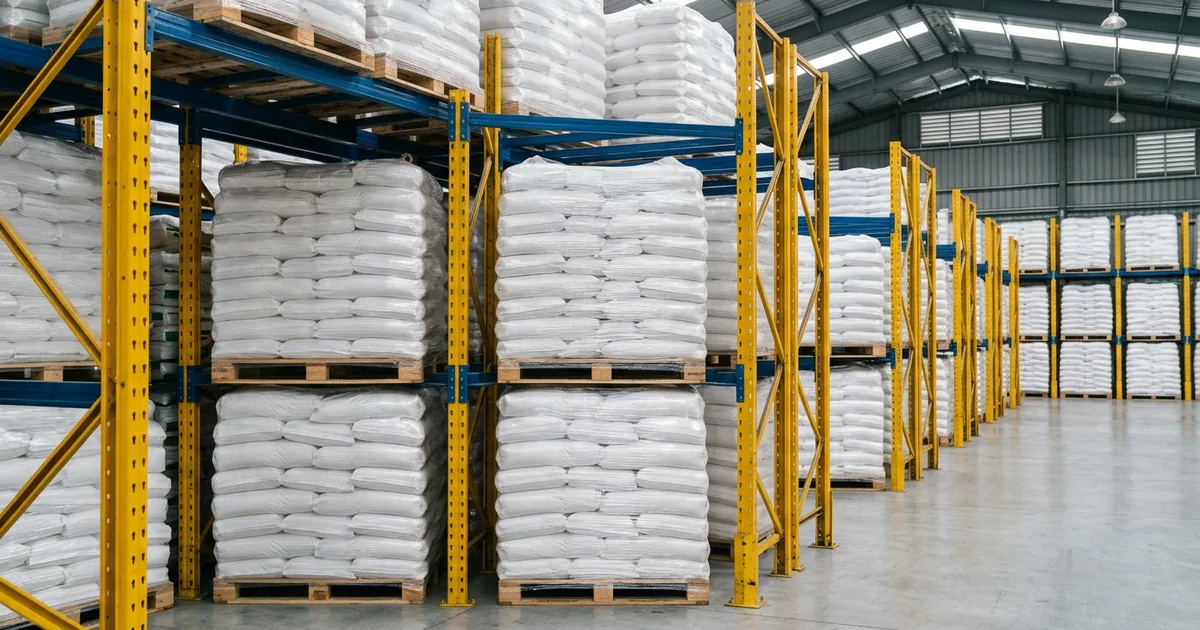
Na₂SO₄is not classified as a dangerous good under UN transport regulations and is non-flammable. High airborne dust during bag dumping can cause mild mechanical eye irritation; operators should wearEN 166safety goggles,N95dust masks, and nitrile gloves, and store50 kgbags on plastic pallets in dry indoor racks (RH ≤ 75%). - For Procurement Teams: Complete ZDHC Gateway / InCheck documentation package (
TÜV SÜD ZDHC MRSL v3.1 Level 1 Certificate No. ZDHC1 127736 0003 Rev. 00+Analytical Test Report No. 2438023996), batch-specific COA, and GHS SDS ready for immediate submission to brand compliance auditors (See full 9-chemical ZDHC portfolio). - For Dyeing & ETP Engineers: Synchronized supply of
TÜV SÜD ZDHC Level 1dyeing auxiliaries including Soda Ash Light Na₂CO₃ 99.2% (Cert No. ZDHC1 127736 0004), Caustic Soda Liquid NaOH 32%–50% (Cert No. ZDHC1 127736 0001), and Hydrogen Peroxide H₂O₂ 50% (Cert No. ZDHC1 127736 0002). - For Accounting Departments: Full legal compliance with Vietnamese VAT e-invoices (
Decree 70/2025/ND-CP), commercial contracts, delivery notes, and non-cash bank transfer documentation for input VAT deduction under the2024 VAT Law.
Pricing Factors & Supply Capacity Across 6 Warehouses
Industrial unit pricing for Na₂SO₄ 99% depends on 5 transparent factors: (1) Order volume (5 – 100+ tons/month), (2) Purity grade & ZDHC certification requirements, (3) Packaging format (50 kg PE-lined bags or 1,000 kg jumbo bags), (4) Delivery distance from our 6 standard warehouses (Ba Ria - Vung Tau, Dong Nai, Binh Duong, Da Nang, Can Tho, Bac Ninh; legal headquarters at 452/6B Tinh Lo 10, Binh Tri Dong Ward, Binh Tan District, HCMC — HQ only, not a warehouse), and (5) Scheduled contract delivery terms.
- Monthly Supply Capacity:
3,000+ metric tons/monthwith a dedicated5–30-tontanker & flatbed truck fleet. - Delivery SLA: Inner Ho Chi Minh City within 4 hours; Southern & Mekong Delta industrial parks within 24–48 hours; Northern & Central Vietnam within 2–3 days (Contact hotline
0979 891 929for detailed delivery scheduling). - Technical Quotation SLA: Within 15 minutes via Hotline / Zalo
0979 891 929or Email[email protected].
7. Frequently Asked Questions (FAQ)
Does Loc Thien Chemical’s Sodium Sulfate Na₂SO₄ 99% hold an official ZDHC MRSL v3.1 Level 1 Certificate?
Yes. Sodium Sulfate Anhydrous Na₂SO₄ 99% supplied by Loc Thien Investment Development Co., Ltd. holds an official ZDHC MRSL Version 3.1 Conformance Level 1 Certificate issued by TÜV SÜD Product Service GmbH (Certificate No. ZDHC1 127736 0003 Rev. 00 | Report No. 2438023996).
Why must Phthalocyanine Turquoise reactive dyes (Reactive Blue 21) use Na₂SO₄ instead of NaCl?
Copper phthalocyanine reactive dyes have a large planar molecular weight and low solubility. Chloride ions (Cl⁻) trigger excessive micellar aggregation that causes unlevel dye specks on cotton. Divalent sulfate ions (SO₄²⁻) in Na₂SO₄ 99% provide controlled, uniform exhaustion and zero stainless steel pitting corrosion.