Sulfuric Acid H2SO4 60% (48.5 °Be · SG 1.50): Specific Gravity Table, Tank Material & Industrial Applications
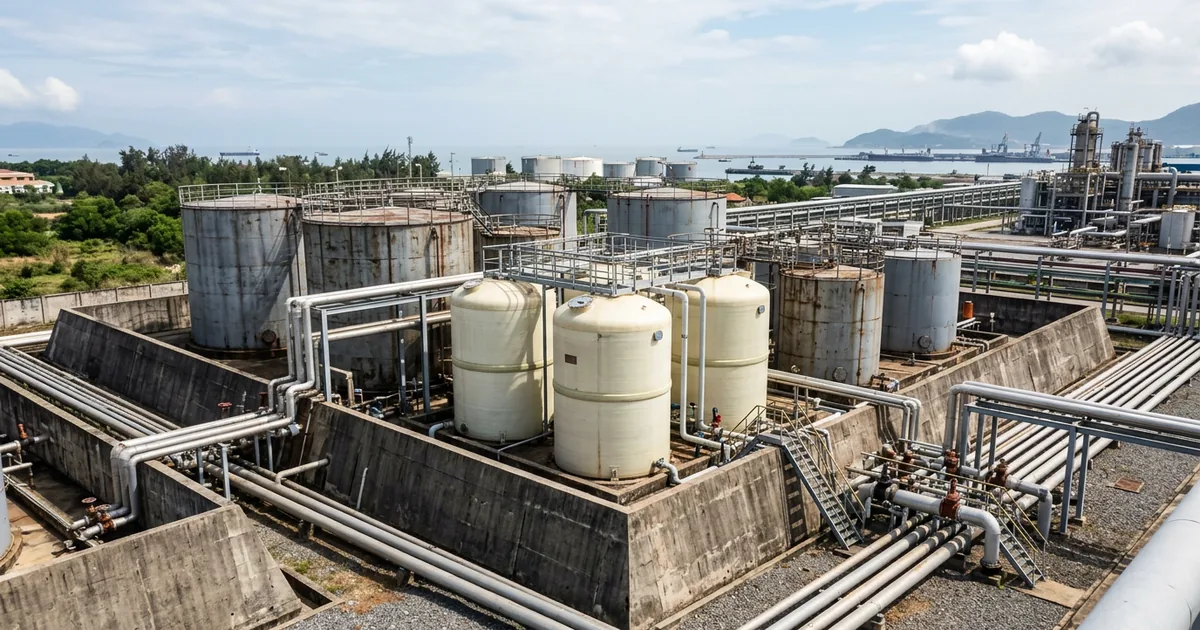
Table of contents
Sulfuric Acid 60% (H₂SO₄ 60% w/w, CAS 7664-93-9, UN 1830) is a standardized medium-concentration inorganic acid exhibiting a specific gravity of 1.498 – 1.502 g/cm³ at 20 °C (~48.5 °Be), delivering ~900 g of pure H₂SO₄ per liter (~9.17 mol/L) with a deep eutectic freezing point (approx. -65 °C). Compared to Concentrated Sulfuric Acid H₂SO₄ 98%, pre-diluted H₂SO₄ 60% eliminates ~65%–70% of exothermic hydration heat, enabling safe direct dosing into automated wastewater pH neutralization skids, lead-acid battery electrolyte tanks, and steel pickling baths without warping plastic piping. Loc Thien Chemical supplies H₂SO₄ 60% with ZDHC MRSL v3.1 Level 1 conformance (TÜV Rheinland CSR #248162921-01) in 1,500 kg IBC totes and dedicated 5–30-ton road tankers from 6 nationwide warehouses — get a technical quote within 15 minutes at 0979 891 929.
1. Physicochemical Properties, Specific Gravity (SG 1.500 g/cm³) & Temperature Curve of H₂SO₄ 60%
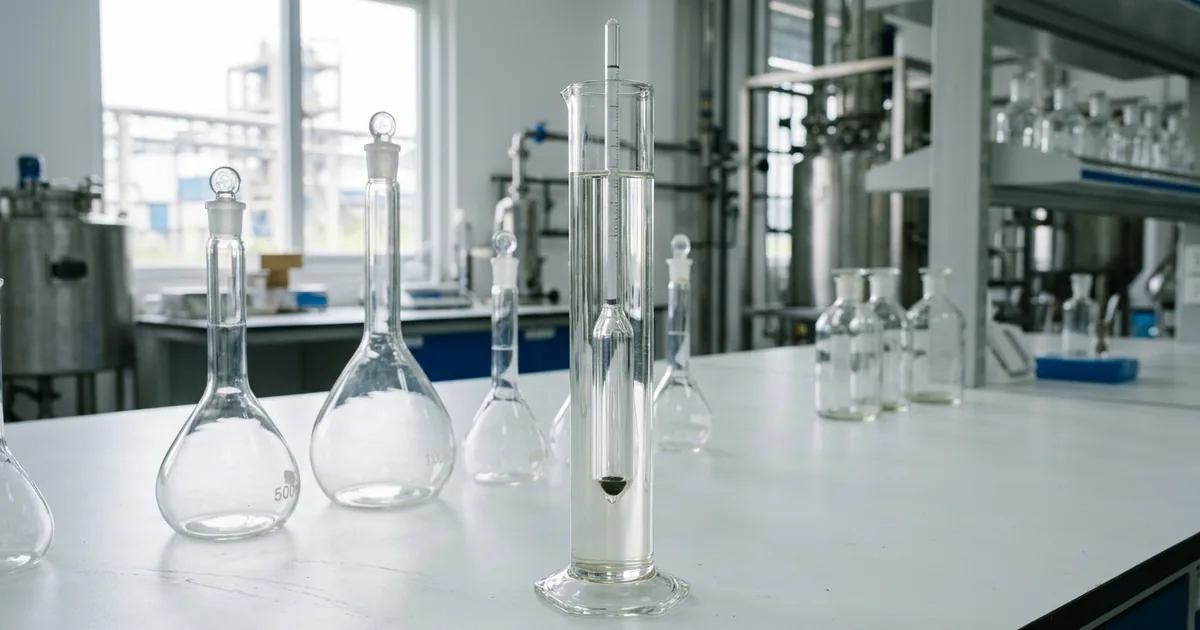
In industrial chemical engineering, distinguishing between mass fraction (% w/w), Specific Gravity (SG or d, g/cm³), and Baume degree (°Be) for Sulfuric Acid H₂SO₄ 60% is essential for accurate receiving inspection and metering pump calibration.
At 60.0% ± 1.0% w/w, H₂SO₄ molecules have undergone complete primary dissociation (pKa₁ ≈ -3.0) and partial secondary dissociation (pKa₂ = +1.99), existing predominantly as stable hydrated ion pairs (H₃O⁺ · HSO₄⁻ and H₅O₂⁺) at a molar ratio of approximately 1 H₂SO₄ : 3.63 H₂O. This molecular structure imparts three vital engineering advantages:
- Standard Density of
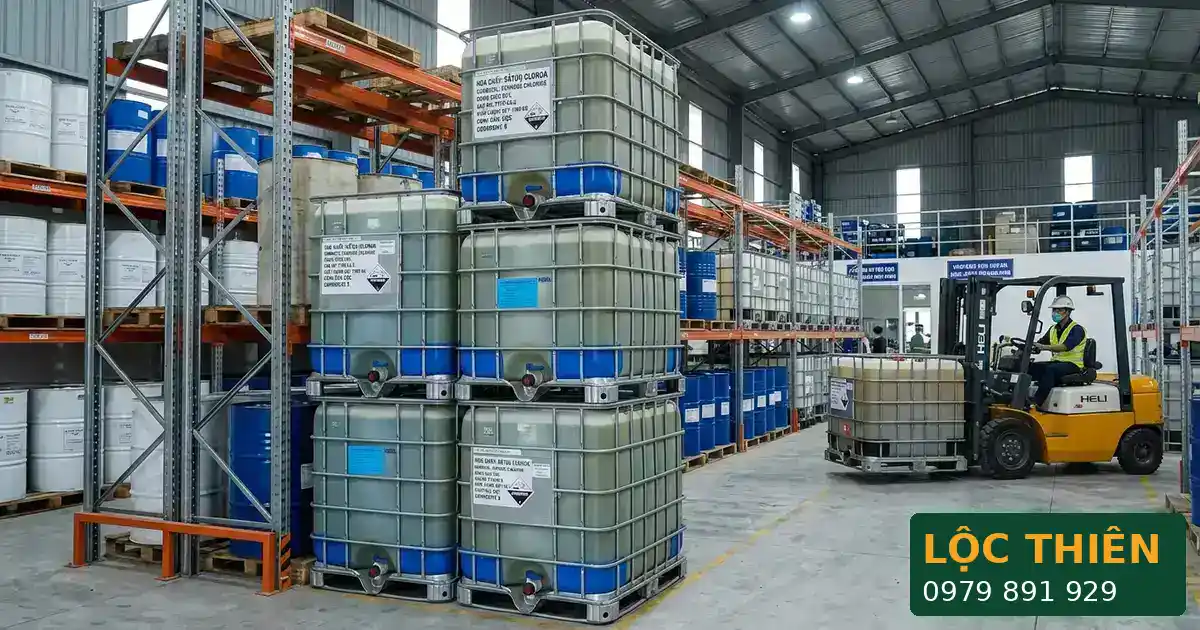
1.498 – 1.502 g/cm³(~1.50 kg/L) at20 °C: Every liter of solution weighs1,500 g, containing899 – 901 g of pure H₂SO₄and~600 g of H₂O. Across our Industrial Acids catalog, one standard1,000 LIBC tote of H₂SO₄ 60% holds~1,500 kg(1.5 metric tonsnet)—distinct from1,000 kgof water or1,840 kgof 98% acid. - Low Kinematic Viscosity (
~5.0 mPa·sat20 °C): Nearly 5 times less viscous than oilyH₂SO₄ 98%(~24.5 mPa·s), allowing electromagnetic and mechanical diaphragm metering pumps to maintain precise suction and stroke repeatability without cavitation. - Deep Eutectic Freezing Point (
Approx. -60 °C to -70 °C): WhereasH₂SO₄ 98%freezes at+3 °CandH₂SO₄ 84%crystallizes at+8.5 °C,H₂SO₄ 60%sits in the deepest eutectic trough of theH₂SO₄–H₂Ophase diagram, guaranteeing zero winter crystallization in outdoor dosing lines.
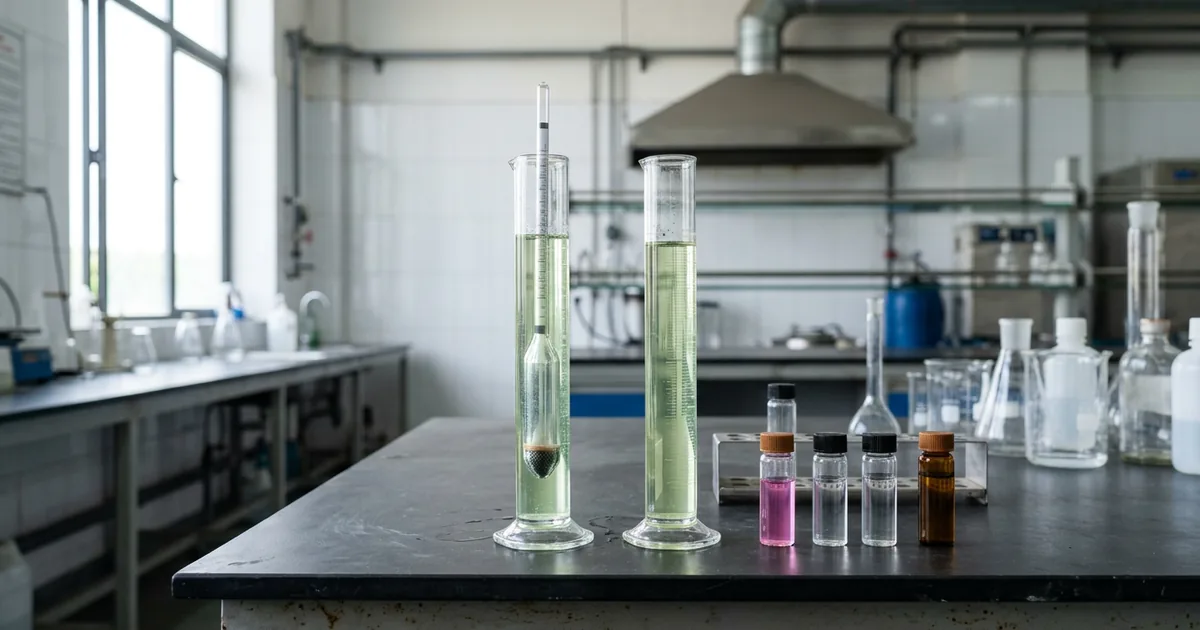
When QC technicians verify incoming batches with a glass hydrometer at ambient plant temperatures T (°C) above 20 °C, thermal expansion lowers the apparent reading by approximately 0.00085 g/cm³ per 1 °C (see full concentration data in our Sulfuric Acid 10% – 98% Specific Gravity & Baume Lookup Table):
Table 1: Specific Gravity, Baume Degree & Viscosity of Sulfuric Acid H₂SO₄ 60.0% (% w/w) Across Temperatures
Sample Temperature (T, °C) | Apparent Hydrometer Reading (d_T, g/cm³) | Equivalent Baume at Temp T (°Be) | Temperature Correction to 20 °C (+Δd) | Active Pure H₂SO₄ Content per Liter at T (g/L) | Dynamic Viscosity (mPa·s or cP) | Metering Pump & Piping Operational Status |
|---|---|---|---|---|---|---|
10 °C | 1.5068 | 48.8 °Be | -0.0085 | 904.1 g/L | 6.8 mPa·s | Smooth diaphragm suction; zero crystallization. |
15 °C | 1.5025 | 48.5 °Be | -0.0042 | 901.5 g/L | 5.8 mPa·s | Standard US reference temperature (60 °F = 15.6 °C). |
20 °C (COA Standard) | 1.4983 – 1.5000 | 48.2 – 48.5 °Be | 0.0000 | 899.0 – 900.0 g/L | 5.0 mPa·s | Standard reference condition for Batch COA. |
25 °C | 1.4940 | 48.0 °Be | +0.0043 | 896.4 g/L | 4.3 mPa·s | Typical air-conditioned QC laboratory temperature. |
30 °C | 1.4898 | 47.7 °Be | +0.0085 | 893.9 g/L | 3.8 mPa·s | Typical daytime warehouse temperature in Southern Vietnam. |
40 °C | 1.4813 | 47.1 °Be | +0.0170 | 888.8 g/L | 3.0 mPa·s | Upper recommended limit for heavy-wall uPVC piping. |
50 °C | 1.4728 | 46.6 °Be | +0.0255 | 883.7 g/L | 2.5 mPa·s | Requires PPH, CPVC, PVDF, or PTFE piping. |
2. Hydration Thermodynamics & Dilution Mass Balance: H₂SO₄ 60% vs. Concentrated H₂SO₄ 98%
Why are FDI textile mills, lead-acid battery plants, and industrial WWTP operators increasingly switching from Concentrated Sulfuric Acid H₂SO₄ 98% to pre-diluted Sulfuric Acid H₂SO₄ 60%? The answer lies in the differential enthalpy of hydration (ΔH_sol):
Diluting 1 mol of anhydrous H₂SO₄ into infinite water releases ΔH ≈ -85.5 to -95.3 kJ/mol (~880 kJ/kg pure H₂SO₄). Crucially, 65% to 70% of this total heat is liberated during the initial hydration step from 98% down to 60% (forming H₂SO₄·H₂O and H₂SO₄·2H₂O hydrates).
When a plant utilizes pre-cooled H₂SO₄ 60% for inline neutralization or secondary dilution to 10% – 36%, the adiabatic temperature rise (ΔT) drops by nearly two-thirds compared to diluting 98% acid:
Table 2: Mass Balance & Adiabatic Temperature Rise (ΔT) for Preparing 1,000 L Working Solutions from H₂SO₄ 60% vs. H₂SO₄ 98%
Target Working Concentration (% w/w) | Target Density at 20 °C (kg/L) | Required H₂SO₄ 60% Mass (kg) | Equivalent H₂SO₄ 60% Volume (L) | Clean Water Added First (L) | Adiabatic Temp Rise ΔT from H₂SO₄ 60% (°C) | Adiabatic Temp Rise ΔT from H₂SO₄ 98% (°C) | Equipment & Process Safety Impact |
|---|---|---|---|---|---|---|---|
10% Solution (pH Dosing) | 1.066 | 177.7 kg | 118.5 L | 888.3 L | +7.5 °C (Mild) | +23.5 °C | Safe direct mixing in HDPE/PP tanks without chillers. |
20% Solution (Steel Pickling) | 1.139 | 379.7 kg | 253.1 L | 759.3 L | +16.4 °C (Safe) | +51.8 °C (~77 °C) | Zero plastic tank softening or acid mist evolution. |
30% Solution (Intermediate) | 1.219 | 609.5 kg | 406.3 L | 609.5 L | +26.8 °C (~52 °C) | +85.4 °C (Boils > 105 °C!) | Eliminates flash-boiling spatter hazards completely. |
36% Solution (Battery Acid) | 1.268 | 760.8 kg | 507.2 L | 507.2 L | +33.5 °C (~58 °C) | +107.0 °C (Violent Boiling!) | Cuts heat-exchanger cooling cycle time by > 60%. |
(Mandatory EHS Rule: Even with reduced hydration heat, always fill the tank with cold water first and feed H₂SO₄ 60% slowly into agitated water).
3. Passive Film Dissolution Mechanism & Storage Tank Material Selection (Carbon Steel Prohibited!)
One of the most dangerous engineering mistakes in industrial plants is repurposing an unlined carbon steel tank (previously used for H₂SO₄ 98%) to store H₂SO₄ 60%.
As detailed in our technical analysis on which metals resist dilute H₂SO₄ vs. concentrated H₂SO₄, concentrated 98% acid forms an insoluble ferrous sulfate (FeSO₄) passive barrier on carbon steel (corrosion rate < 0.15 mm/year below 40 °C). However, at 60% w/w concentration (40% free water), this FeSO₄ film dissolves immediately into the aqueous phase, exposing bare iron to ~9.17 M hydronium ions:
Corrosion rates on bare carbon steel in H₂SO₄ 60% exceed 15 – 50 mm/year, perforating tank walls within days while accumulating explosive hydrogen gas (H₂) in the tank headspace and contaminating the acid with dissolved iron (Fe²⁺).
Table 3: Material Compatibility Matrix for Sulfuric Acid H₂SO₄ 60% Storage Tanks, Piping & Elastomers (20 – 50 °C)
| Equipment Component | Optimal Recommended Material (Grade A — Excellent) | Conditional Material (Grade B — Temp Limited) | STRICTLY PROHIBITED (Grade X — Rapid Failure) |
|---|---|---|---|
Bulk Storage Tanks (5 – 50 m³) | Cross-Linked PE (XLPE), Heavy-Wall Virgin HDPE (≥ 18–25 mm), Vinyl Ester FRP, PTFE-Lined or Butyl-Rubber-Lined Steel | Butt-welded PP-H tanks (recommended ≤ 20 m³ with external steel reinforcing cages) | Unlined Carbon Steel (SS400, A36, CT3), 304 SS, Standard 316L SS, Aluminum, Ortho-Polyester FRP |
| Piping & Isolation Valves | PVDF, PTFE, PPH PN10/PN16, Schedule 80 CPVC | Heavy-wall PN16 uPVC (strictly < 35 °C, shaded from direct sunlight) | Galvanized steel, copper, 304/316 stainless steel, cast iron |
| Metering & Transfer Pumps | PVDF or PTFE diaphragm metering pumps; FEP/PFA-lined magnetic drive pumps; Alloy 20 / Hastelloy C-276 | Polypropylene (PP) liquid ends (ambient service < 35 °C) | Cast iron pumps, standard 304/316 stainless steel centrifugal pumps |
| Gaskets & O-Rings | Viton (FKM), Virgin PTFE (Teflon), Acid-Grade EPDM | Butyl Rubber (IIR) | Natural Rubber (NR), Nitrile (NBR/Buna-N), Neoprene |
Field QC Engineering Insight — Phan Cam Thuy (Quality Control Specialist, Loc Thien Chemical): “Before our
5–30-tonroad tankers unloadH₂SO₄ 60%into a customer’s bulk tank, our delivery crew inspects the tank nameplate and Camlock manifold material. If an unlined carbon steel or 304 stainless steel vessel is identified, we halt unloading immediately and transition the plant to1,000 Lvirgin HDPE IBC totes (1,500 kgnet) to prevent catastrophic corrosion and hydrogen hazards.”
4. Four Core Industrial Applications & Illustrative Engineering Dosing Example
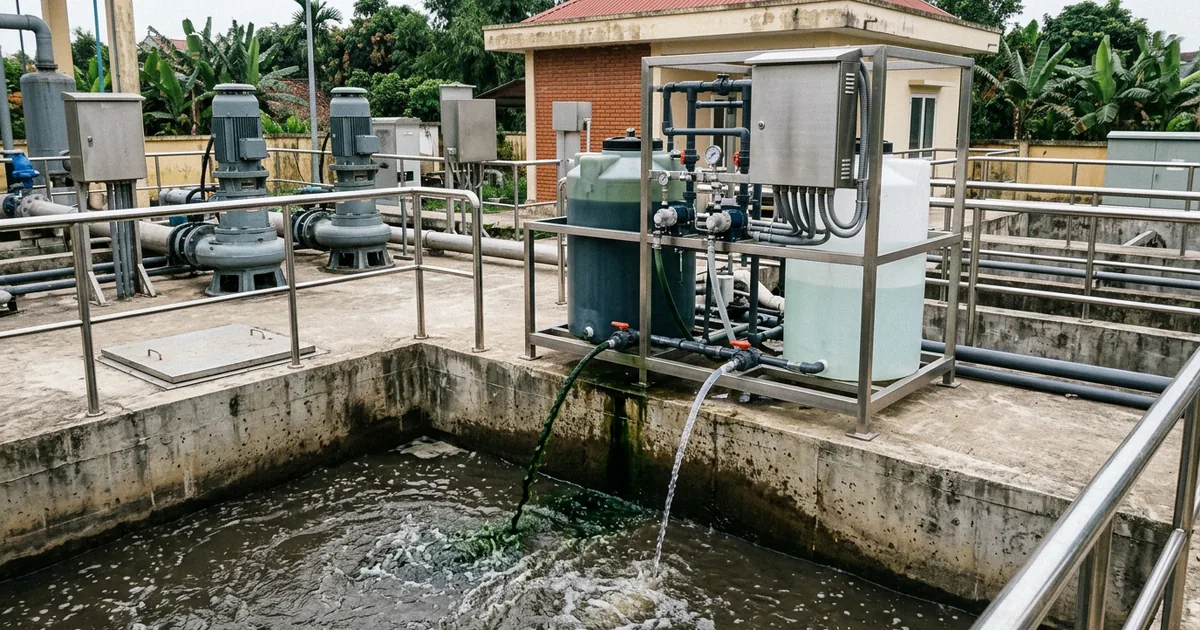
- Automated Alkaline Wastewater pH Neutralization (Textile Dyeing, Paper, Electroplating):
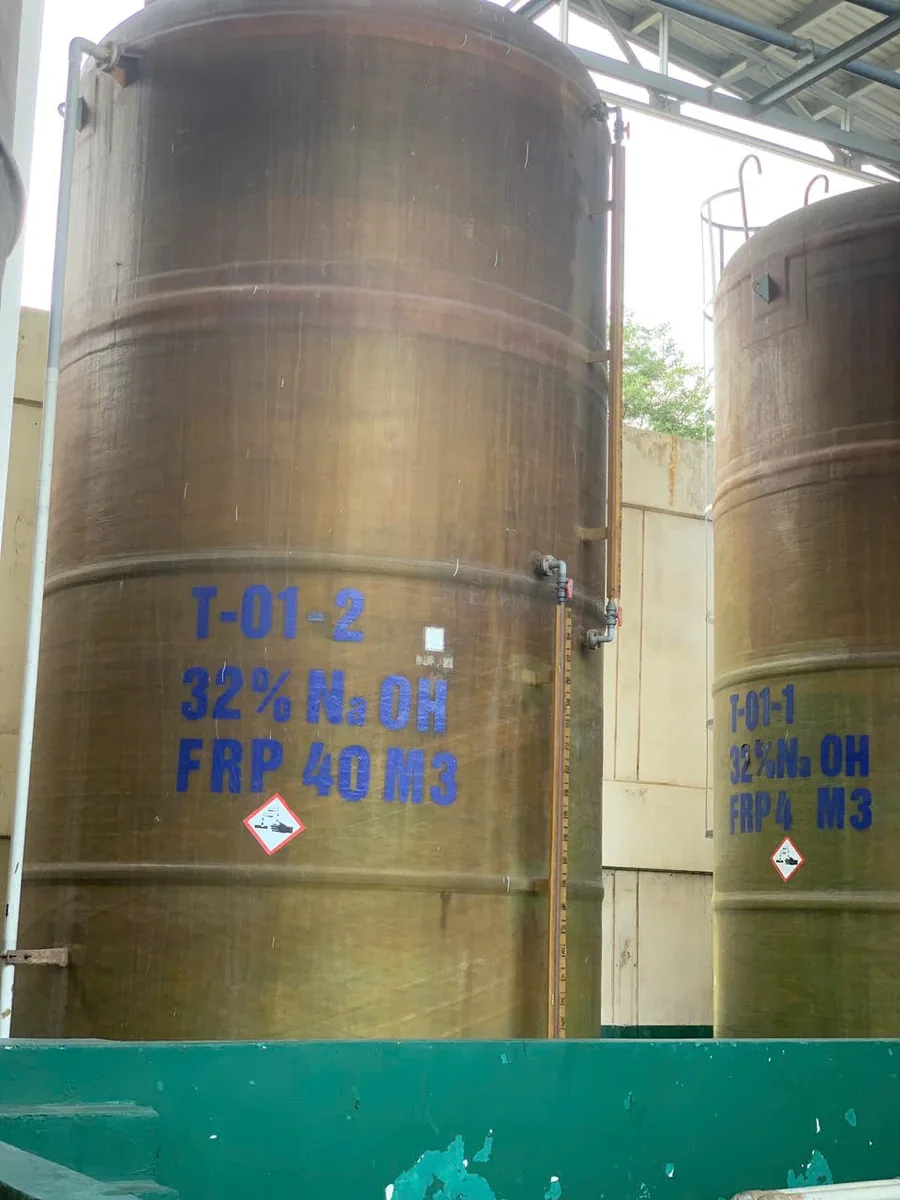
Factories using Liquid Caustic Soda NaOH 32% generate alkaline effluent at
pH 11.0 – 12.5. Dosing Sulfuric Acid H₂SO₄ 60% via PID metering pumps smoothly adjusts pH to6.8 – 8.0ahead of coagulation with Ferrous Chloride FeCl₂ 30% or PAC to meetQCVN 40:2025/BTNMT. Unlike Hydrochloric Acid HCl 32%,H₂SO₄ 60%emits zero corrosive HCl vapor and adds zero chloride ions (Cl⁻) (see our comparison of HCl vs. H₂SO₄ for industrial neutralization).- Illustrative Engineering Calculation (Stated Assumptions): A
1,500 m³/dayWWTP neutralizing5.0 mmol OH⁻/Lresidual alkalinity requires2.5 mmol H₂SO₄/L = 245.2 g pure H₂SO₄/m³, or367.8 kg/dayof 100% H₂SO₄. UsingH₂SO₄ 60%(0.60 kg H₂SO₄/kgor0.90 kg H₂SO₄/L), the theoretical requirement is613 kg/day(~408.7 L/day). Always verify final dosing via bench-scale Jar-tests on actual plant effluent.
- Illustrative Engineering Calculation (Stated Assumptions): A
- Lead-Acid Battery Electrolyte Formulation:
Serves as a low-iron (
Fe ≤ 50 ppm,As ≤ 1 ppm) master batch for diluting to32% – 38%electrolyte (SG = 1.240 – 1.285 g/cm³) (details in H₂SO₄ specifications for battery manufacturing). - Hot-Rolled Steel Pickling & Surface Descaling:
Replenishes
15% – 22%pickling baths at60 – 75 °Cto remove mill scale (FeO, Fe₃O₄, Fe₂O₃) without thermal shock at the acid makeup nozzle. - Cooling Tower Alkalinity Control & Chemical Processing:
Controls Langelier Saturation Index (LSI) to prevent
CaCO₃scaling in condenser tubes, starch hydrolysis, and sulfate salt synthesis (see industrial applications of H₂SO₄ and our Complete Sulfuric Acid H₂SO₄ Engineering Guide).
5. 2026 Group 2 Precursor Compliance, ZDHC MRSL v3.1 Level 1 & 5–30-Ton Tanker Logistics
When procuring Sulfuric Acid H₂SO₄ 60% in Vietnam during 2026, B2B buyers and EHS managers rely on three compliance pillars:
- Group 2 Industrial Precursor Compliance (
Law on Chemicals 69/2025/QH15&Decree 24/2026/ND-CP): All liquid mixtures containing≥ 5% w/w H₂SO₄(includingH₂SO₄ 60%) are regulated as Group 2 Industrial Precursors. Domestic purchases require an Industrial Precursor Purchase & Sale Control Slip under Circular 01/2026/TT-BCT paired with compliant electronic VAT invoices issued byLOC THIEN INVESTMENT DEVELOPMENT COMPANY LIMITED(Tax ID:0313650856; Legal HQ:452/6B Tinh Lo 10, Binh Tri Dong Ward, Binh Tan District, Ho Chi Minh City). For Export Processing Enterprises (EPEs), Loc Thien supports precursor import/export licensing underDecree 25/2026/ND-CP. ZDHC MRSL Version 3.1 Conformance Level 1: Evaluated by TÜV Rheinland Vietnam under CSR & Analytical Test Report No.248162921-01(issued October 22, 2024) as part of Loc Thien’s 9-product ZDHC Level 1 portfolio (4 TÜV SÜD CertificatesZDHC1 127736 0001–0004:NaOH, H₂O₂, Na₂SO₄, Na₂CO₃and 5 TÜV Rheinland CSR/Test Reports248162921-01–05:H₂SO₄, FeCl₂, HCl, Javel/NaOCl, PAC 31%).- 3,000+ MT/Month Supply Capacity, 6 Nationwide Warehouses & Delivery SLA: Dispatched from Ba Ria - Vung Tau (Phu My 1 IP), Dong Nai (Long Thanh IP), Binh Duong (Di An), Da Nang (Hoa Khanh IP), Can Tho (Tra Noc IP), and Bac Ninh (Tien Son IP) via
5–30-tondedicated tankers and IBC trucks. Guaranteed delivery within 4 hours in inner HCMC, 24–48 hours across Southern & Mekong Delta industrial zones, and 2–3 days in Northern & Central Vietnam. Contact hotline0979 891 929for detailed delivery scheduling.
6. Frequently Asked Questions (FAQ) on Industrial Sulfuric Acid H₂SO₄ 60%
1. What is the standard specific gravity and Baume degree of Sulfuric Acid H₂SO₄ 60% at 20 °C?
At 20 °C, Sulfuric Acid H₂SO₄ 60% (% w/w) has a specific gravity of 1.498 – 1.502 g/cm³ (~1.50 kg/L), equivalent to 48.2 – 48.5 °Be, containing ~900 g pure H₂SO₄/L. One 1,000 L IBC tote holds ~1,500 kg (1.5 MT net).
2. Why is unlined carbon steel strictly prohibited for storing H₂SO₄ 60%?
At 60% w/w (40% free water), the protective FeSO₄ passive film dissolves completely, causing rapid acid attack on iron (Fe + H₂SO₄ → FeSO₄ + H₂↑), wall perforation, and explosive hydrogen gas evolution. Storage tanks must use XLPE, heavy-wall HDPE, PP, PVDF, or Vinyl Ester FRP.
3. How much dilution heat is saved by using H₂SO₄ 60% instead of H₂SO₄ 98%?
Using pre-diluted H₂SO₄ 60% eliminates ~65%–70% of the exothermic hydration heat compared to diluting Concentrated Sulfuric Acid H₂SO₄ 98%, protecting plastic piping, metering pumps, and plant operators.
4. How is unit pricing calculated and how fast can Loc Thien provide a quote?
Unit pricing is determined by 5 transparent B2B factors: (1) concentration & COA purity specs, (2) packaging format (45 kg cans, 300 kg drums, 1,500 kg IBC totes, or 5–30-ton tankers), (3) order volume, (4) delivery distance from our 6 warehouses, and (5) ZDHC/EPE documentation requirements. Request a formal quotation within 15 minutes via our online RFQ form or hotline 0979 891 929 ([email protected]).